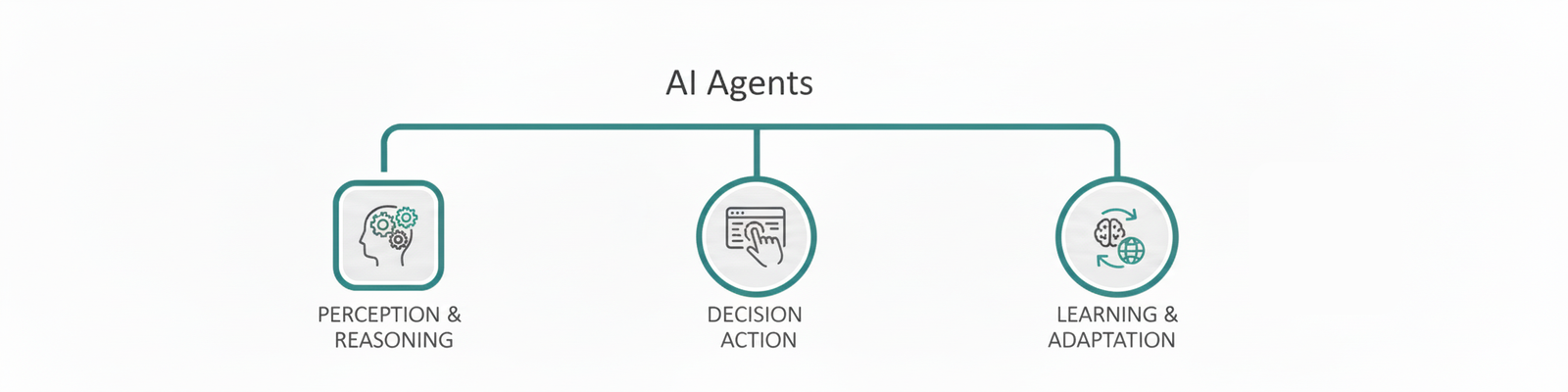
AI Agents
AI Agents: From Intent to Action.
AI Agents are autonomous software systems that use large language models (LLMs) and specialized tools to perceive their environment, reason, plan multi-step workflows, and act to achieve a complex goal with minimal human intervention. Unlike simple chatbots that follow pre-defined scripts, advanced AI agents can break down ambiguous requests, coordinate with other agents or systems, learn from their performance, and adapt their strategy in real-time. By automating entire processes—from sales research and IT support to content creation and financial reconciliation—AI Agents enhance employee productivity, drive operational efficiency 24/7, and unlock new levels of business agility and personalized customer experience.
Custom Agent Strategy and Design
Custom Agent Strategy and Design
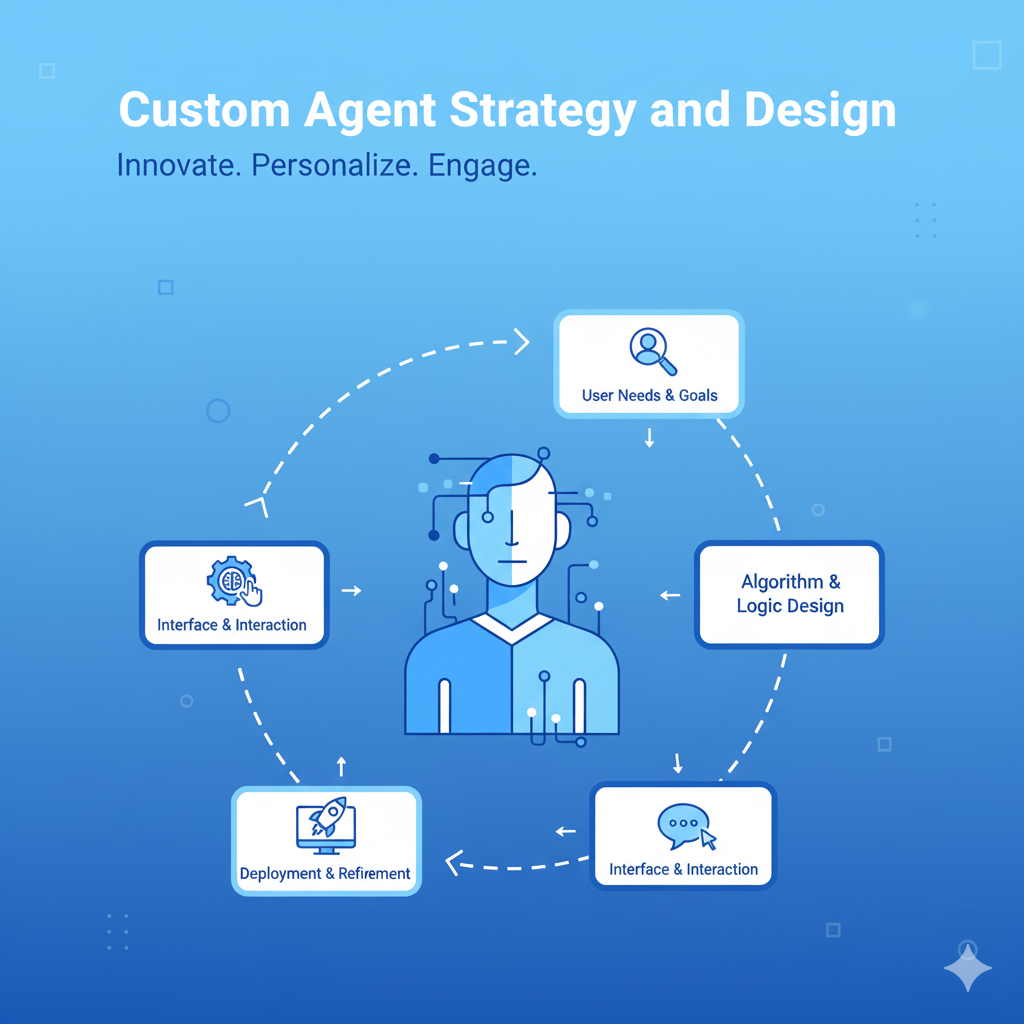
Custom Agent Strategy and Design is the foundational service that translates a company’s strategic goals into a deployable plan for advanced AI Agents. This phase is critical because it moves beyond generic AI concepts to identify specific, high-value business processes ripe for autonomous automation. We conduct deep dives into your operational workflows, data architecture, and organizational structure to determine the optimal type, number, and collaboration model (single-agent vs. multi-agent systems) needed to achieve defined KPIs, such as revenue increase or cost reduction. The output is a clear, prioritized roadmap and a detailed blueprint for the agent’s architecture, tools, safety protocols, and integration points, ensuring the AI investment delivers measurable business impact.
Our Services
- Value Stream Mapping and Use Case Identification We meticulously map your end-to-end value streams to identify and prioritize specific, complex tasks where autonomous AI Agents can yield the highest ROI and solve critical operational bottlenecks.
- Agent Architecture Blueprinting We design the internal architecture of the agent—defining its core LLM, reasoning engine, memory management, tool-use capability, and the necessary data grounding layers to ensure performance and context retention.
- Multi-Agent System Planning For complex workflows, we design collaborative multi-agent systems, defining the roles, communication protocols, and delegation logic for a team of specialized agents (e.g., a “Researcher Agent” and a “Validator Agent”).
- Risk Assessment and Safety Protocol Definition We conduct a thorough risk assessment for autonomous actions, defining guardrails, human-in-the-loop escalation points, and ethical constraints to ensure agents operate safely and within corporate policy.
- Technology Stack and Integration Roadmapping We recommend the optimal technology stack (cloud providers, open-source frameworks, proprietary tools) and create a phased roadmap for integrating the new agent systems with your existing enterprise applications.
Agent Development and Tool Integration
Agent Development and Tool Integration
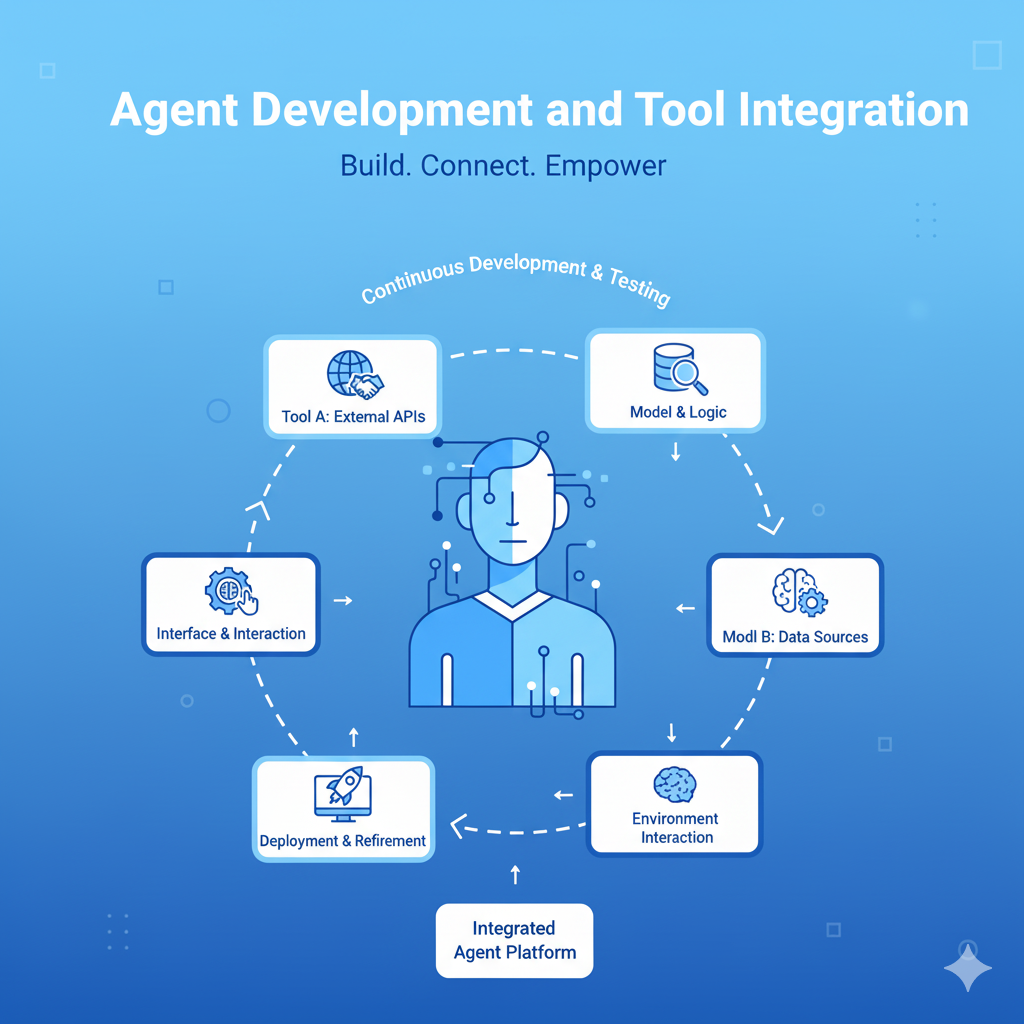
Agent Development and Tool Integration is the core engineering process that transforms an abstract AI Agent design into a functional, acting entity capable of executing real-world tasks. This service involves programming the Large Language Model (LLM) to become proficient at Tool Use—the mechanism by which the agent interacts with external systems like databases, APIs, and enterprise applications. By developing secure, standardized tools (functions) and integrating them seamlessly, we enable the agent to perform actions beyond generating text, such as retrieving real-time data, updating customer records in a CRM, or executing code. This capability is what unlocks the agent’s autonomy and its ability to deliver tangible, transactional business outcomes.
Our Services
- Custom Tool and API Wrapper Development We develop specialized toolkits (functions) that serve as the agent’s “hands,” enabling secure and precise interaction with your existing enterprise software and external web services via custom-built API wrappers.
- Tool-Calling Optimization and Reliability We engineer the agent’s prompt and reasoning mechanisms to reliably decide when to call a tool, which tool to call, and how to format the input parameters, minimizing hallucination and execution errors.
- Sandboxed Code Execution Environments For agents requiring data analysis, manipulation, or complex logic, we implement secure, sandboxed code interpreters (e.g., Python execution environments) to allow the agent to run code safely and return results.
- Integration with Agent Frameworks We leverage industry-leading agent frameworks like LangChain, LangGraph, or CrewAI to streamline development, manage the agent’s memory, and simplify the orchestration of complex, multi-step tasks.
- Data Retrieval and Augmentation (RAG) Tools We integrate tools for Retrieval Augmented Generation (RAG), connecting the agent to your Vector Databases and internal knowledge bases to ensure its actions and decisions are grounded in your proprietary, up-to-date business data.
Autonomous Workflow Orchestration
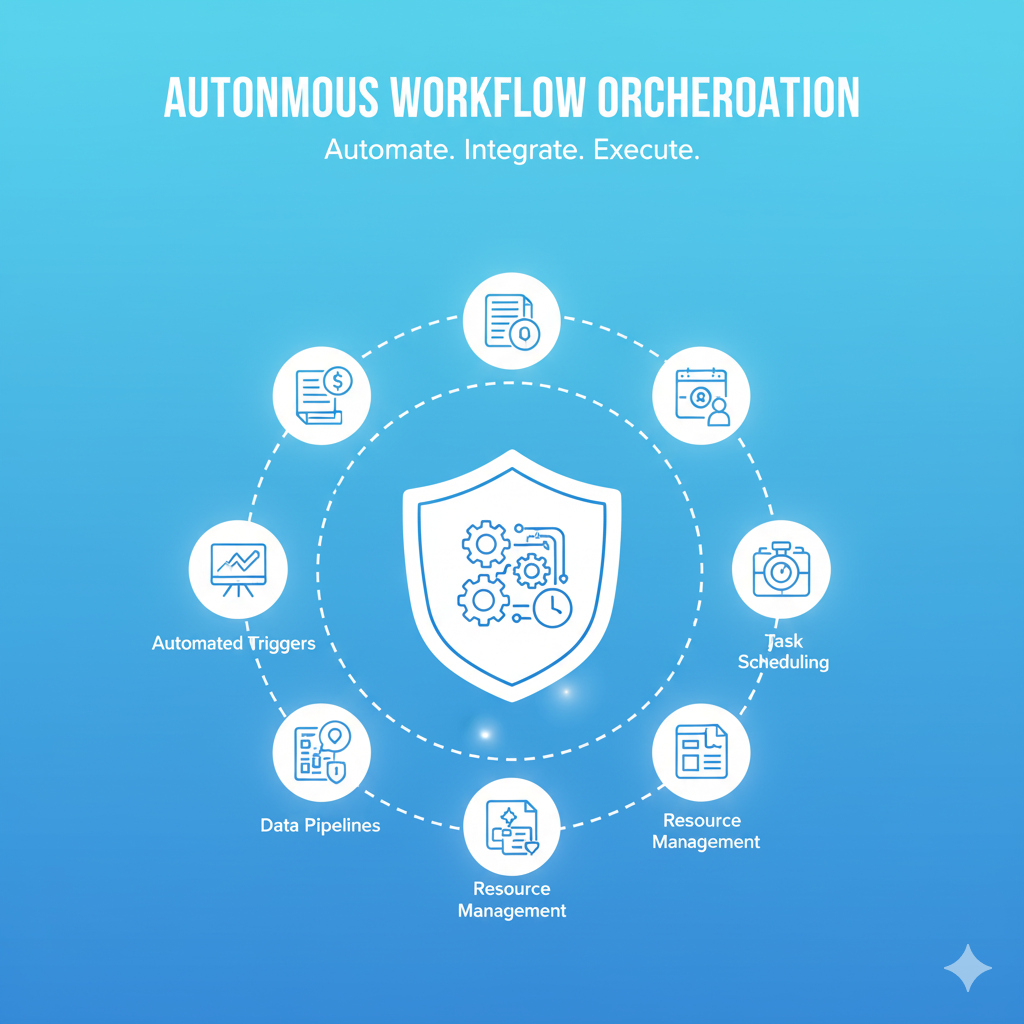
Autonomous Workflow Orchestration
Autonomous Workflow Orchestration is the strategic coordination and management of multiple specialized AI Agents to complete complex, end-to-end business processes without manual intervention. This service establishes a “master control layer” that functions as a project manager, dynamically breaking down high-level goals into subtasks, delegating them to the right specialized agents (e.g., a “Research Agent,” a “Data Agent,” and a “Communication Agent”), and ensuring seamless data and context transfer between them. This capability is critical for moving beyond simple, single-step automation to achieving full process automation, leading to dramatically reduced cycle times, improved process reliability, and increased scalability across enterprise-wide operations.
Our Services
- Multi-Agent System Implementation We deploy and configure advanced multi-agent frameworks (such as LangGraph or CrewAI) to enable seamless collaboration, shared memory, and structured communication between diverse, specialized agents.
- Centralized Control and Delegation Logic We design and implement the central Orchestrator Agent (or a centralized control flow) responsible for dynamic task decomposition, sequencing, conditional routing, and assigning subtasks based on real-time context and agent availability.
- State Management and Context Persistence We implement robust context management and state-tracking mechanisms (memory) to ensure agents maintain awareness of the overall workflow progress and seamlessly hand off relevant information at each step.
- Resilient Error Handling and Fallback Protocols We design and embed sophisticated error detection, automated retry logic, and clearly defined human-in-the-loop (HITL) escalation pathways to ensure workflow resilience and prevent processes from stalling.
- Process Monitoring and Auditability We provide a visual and auditable view of the end-to-end workflow, logging every agent action, tool call, and decision point, ensuring transparency and compliance while providing data for continuous process optimization.
Performance Monitoring and Governance
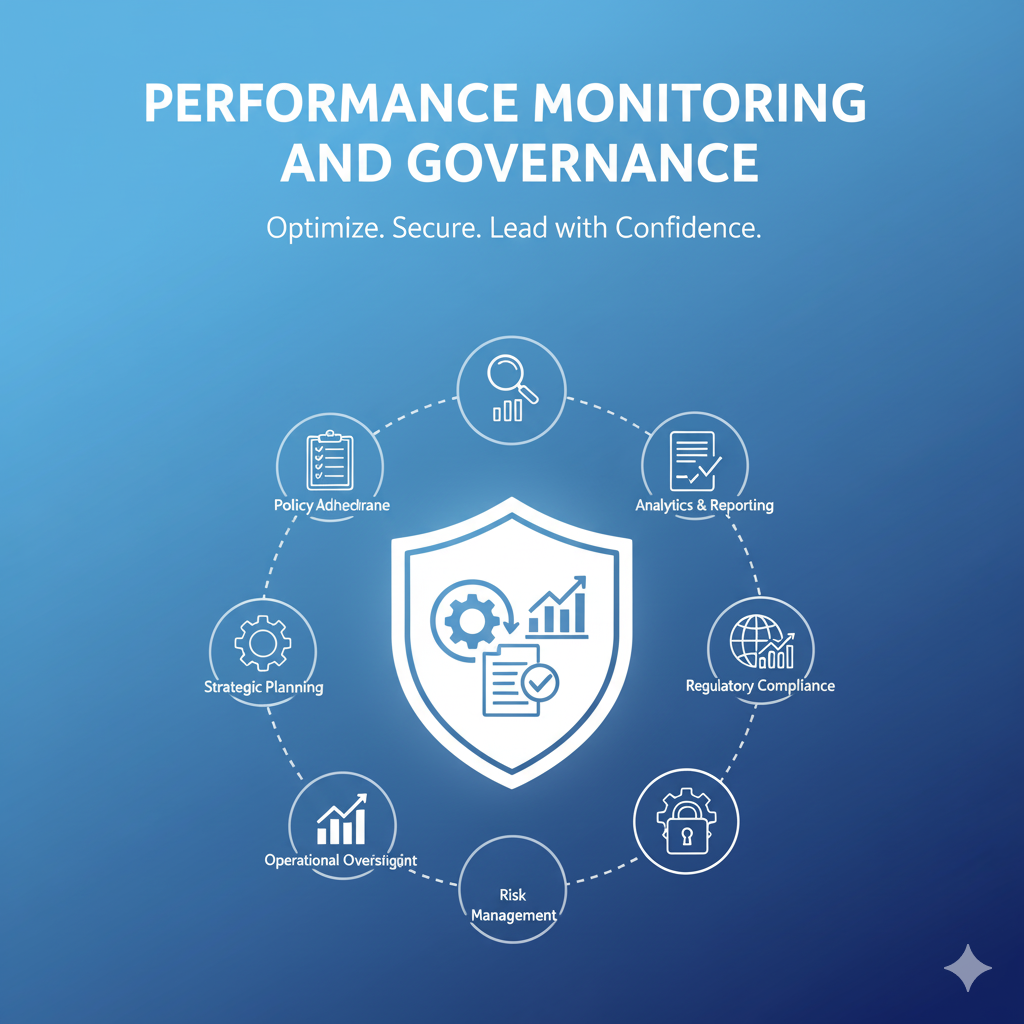
Performance Monitoring and Governance
Performance Monitoring and Governance is the critical framework that ensures AI Agents operate reliably, ethically, and in alignment with business objectives once they are deployed into production. This service establishes constant, real-time observation of the agent’s behavior, tracking key metrics like response accuracy, latency, and business impact (e.g., successful task completion rate). Crucially, it embeds a governance layer with guardrails and oversight mechanisms to detect and prevent deviations, such as generating harmful content, exhibiting bias, or attempting unauthorized actions. This infrastructure is essential for building trust, maintaining regulatory compliance, and safely scaling the use of autonomous agents across the enterprise.
Our Services
- Real-Time Observability Dashboards We implement customized, centralized dashboards (using tools like Grafana, Datadog, or specialized AI observability platforms) to provide a single view of technical performance (latency, uptime, token cost) and operational metrics.
- Anomaly and Drift Detection We set up continuous monitoring to detect operational anomalies, including unexpected resource spikes, drift in the agent’s output quality, and sudden changes in behavior that signal potential issues or security risks.
- Compliance and Guardrail Enforcement We design and deploy technical guardrails (content filters, policy checks) to ensure agents adhere strictly to internal compliance rules, ethical standards, and brand guidelines, blocking non-compliant or risky actions before execution.
- Accountability and Audit Trail Logging We establish immutable, detailed audit trails that log every agent action, tool call, decision-making step, and the exact data used, ensuring full transparency and accountability for any agent-driven outcome.
- Human-in-the-Loop (HITL) Intervention Triggers We define and implement triggers that automatically escalate high-risk or ambiguous decisions to human review queues, giving operators the power to inspect, approve, or override an agent’s autonomous action.
Agent Fine-Tuning and Knowledge Grounding
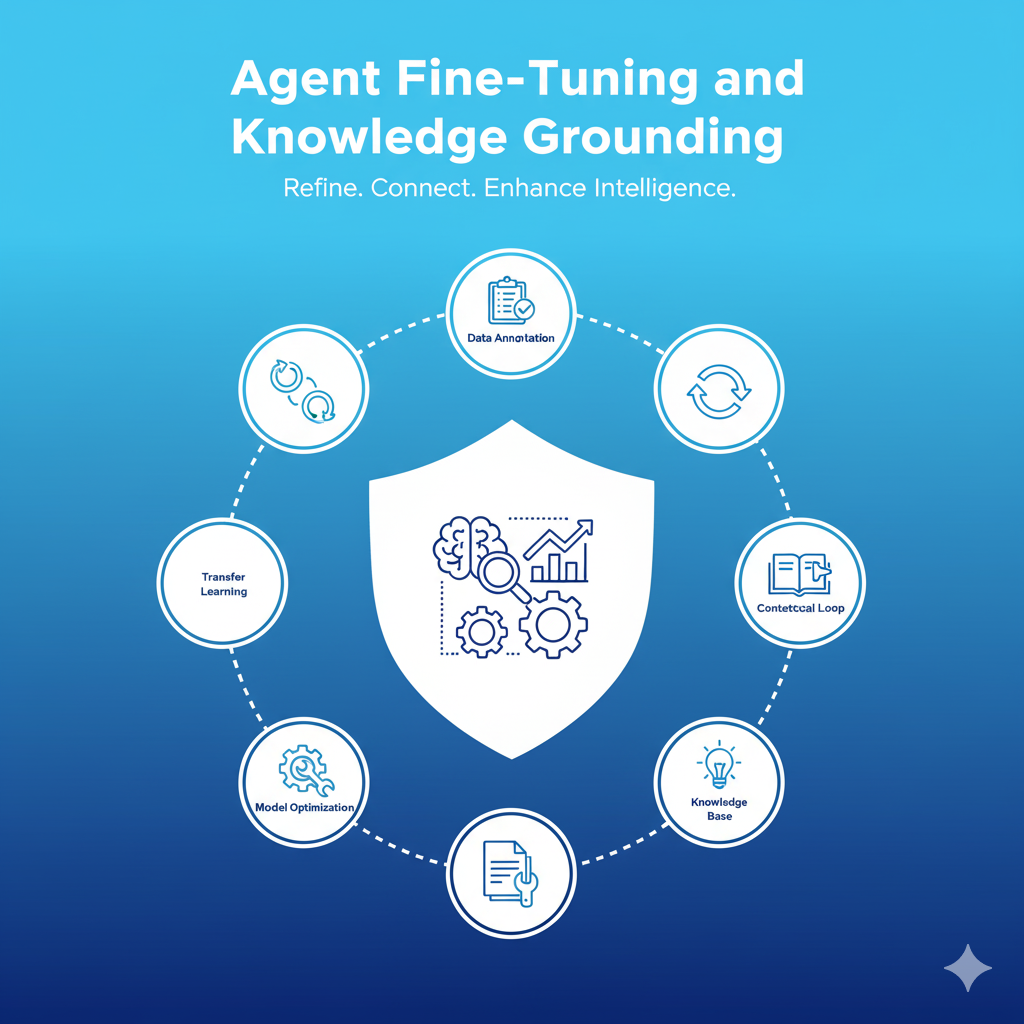
Agent Fine-Tuning and Knowledge Grounding
Agent Fine-Tuning and Knowledge Grounding is the process of specializing a general-purpose AI agent to become an expert in a company’s specific domain, terminology, and data. Fine-tuning adjusts the underlying Large Language Model (LLM) itself using smaller, high-quality, proprietary datasets, making it deeply fluent in the client’s language and capable of consistent, high-precision tasks. Knowledge Grounding—often implemented via Retrieval-Augmented Generation (RAG)—connects the agent to real-time, private, and current data sources (e.g., internal documents, databases), ensuring its responses are factually accurate, auditable, and free from common “hallucinations,” thereby unlocking true enterprise-grade performance.
Our Services
- Retrieval-Augmented Generation (RAG) System Design We design and implement RAG pipelines that connect your AI Agent to proprietary data sources, including document repositories, knowledge bases, and live databases, ensuring responses are grounded in the most current and relevant facts.
- Vector Database Setup and Management We select, configure, and manage vector databases (e.g., Pinecone, Weaviate, or cloud-native solutions) to efficiently store and retrieve data embeddings, which are essential for the RAG system’s high-speed semantic search capabilities.
- Proprietary Data Preparation and Chunking We cleanse, structure, and segment your unstructured internal documents into optimized “chunks” and create high-quality vector embeddings to maximize retrieval accuracy and minimize context window usage for the LLM.
- Model Fine-Tuning and Customization We perform targeted fine-tuning (e.g., using techniques like LoRA or QLoRA) on open-source or commercial base models to infuse them with your unique tone, terminology, and required task behavior (e.g., legal or medical compliance formatting).
- Hybrid Grounding Strategy We develop a comprehensive strategy that combines the strengths of both fine-tuning (for style and core domain understanding) and RAG (for real-time, up-to-date facts) to achieve maximum accuracy and utility in complex agent tasks.