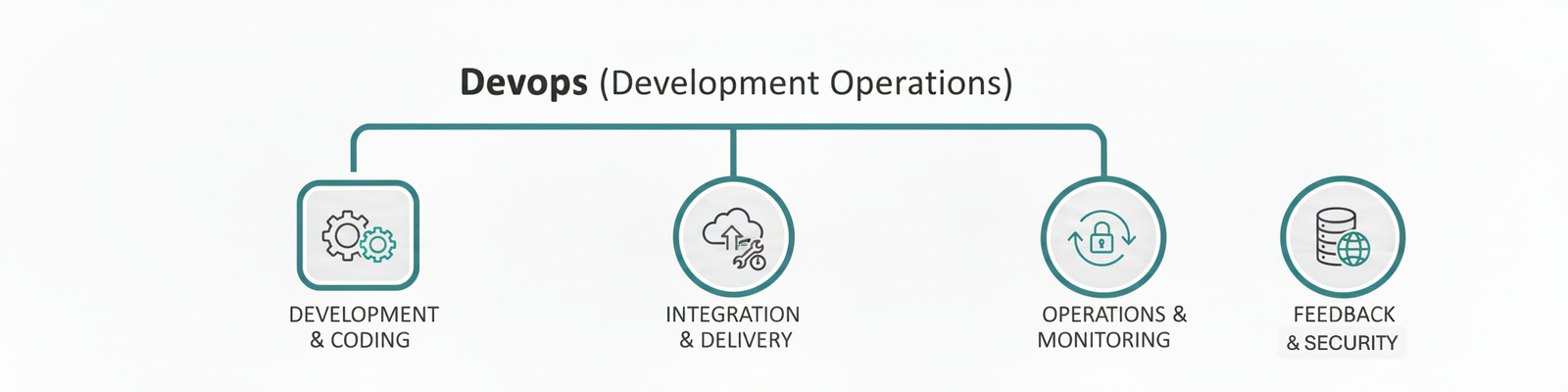
DevOps (Development Operations)
DevOps: Breaking Down Walls, Building Better Software.
DevOps is a cultural philosophy, set of practices, and toolchain that unifies software development (Dev) and IT operations (Ops) teams. The primary goal is to shorten the system development lifecycle and provide continuous delivery of high-quality software. By implementing automation, establishing rapid feedback loops, and fostering a culture of shared ownership and collaboration, DevOps enables organizations to build, test, and release new features and fixes at high velocity and with greater reliability than traditional processes. This translates directly to faster time-to-market, improved system stability, and a competitive edge in rapidly evolving markets.
DevOps Strategy and Consulting
DevOps Strategy and Consulting
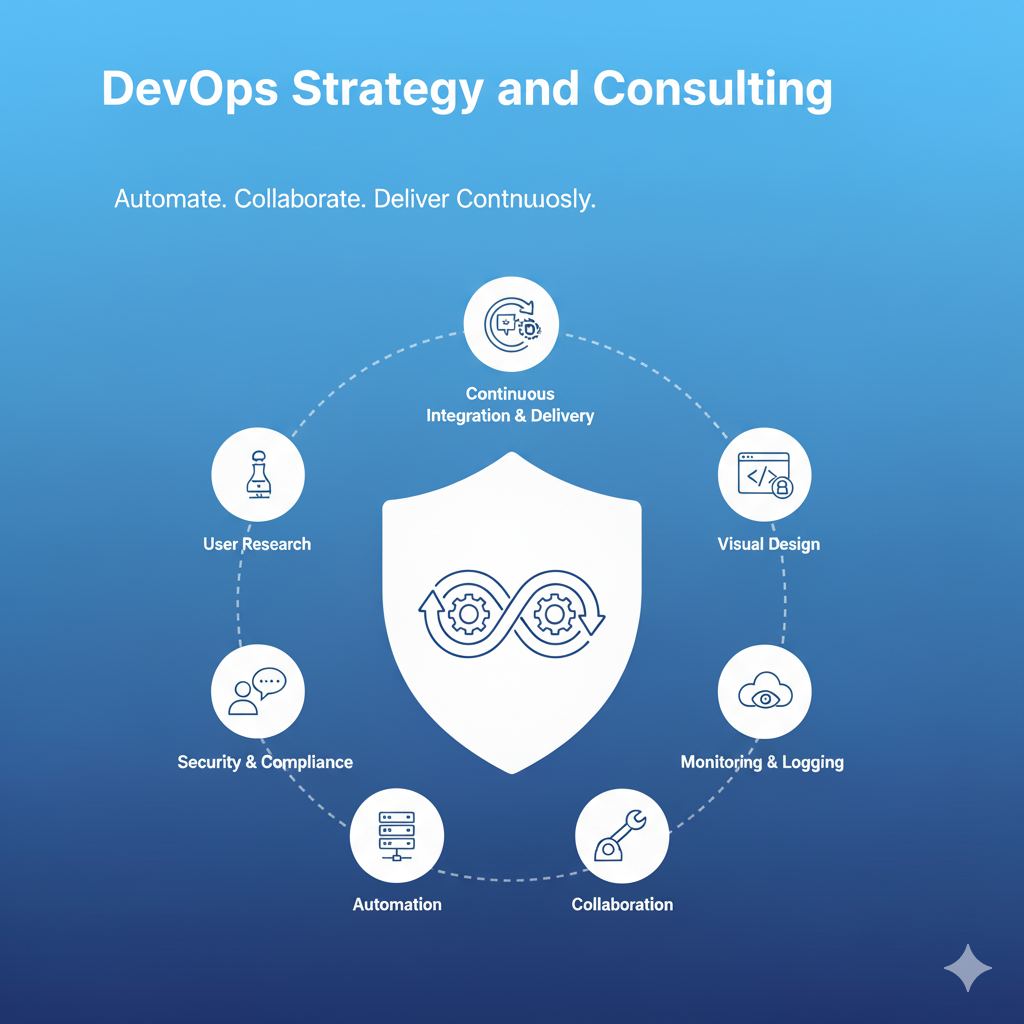
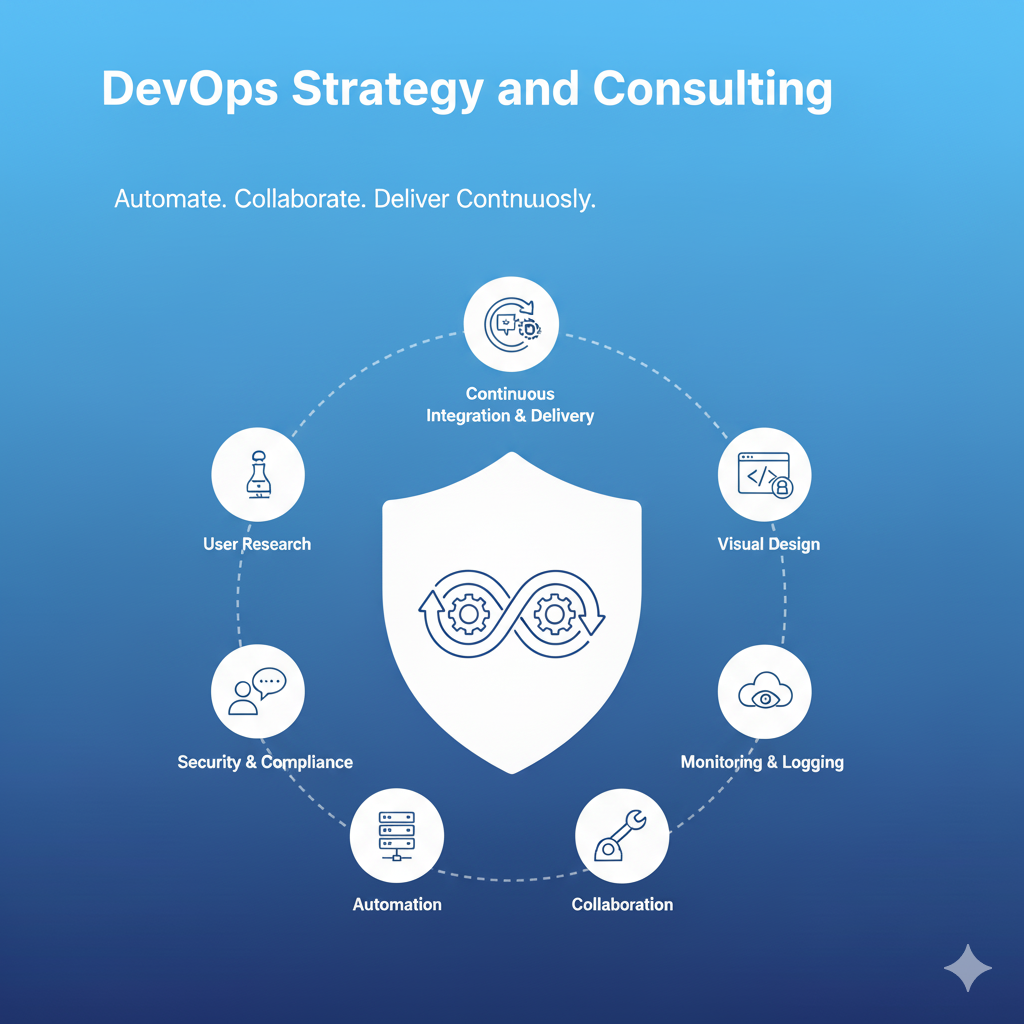
DevOps Strategy and Consulting is the advisory service that guides organizations through the cultural and technical transformation required to implement DevOps principles effectively. Our consultants act as architects, performing a deep-dive assessment of your current workflow, identifying key organizational bottlenecks, and measuring process maturity. The deliverable is a clear, prioritized DevOps Roadmap that aligns automation goals (CI/CD, IaC, Monitoring) with core business objectives (speed, reliability, cost reduction). This strategic partnership ensures the transition to DevOps is smooth, scalable, and results in a lasting cultural shift toward shared responsibility and continuous improvement.
Our Services
- DevOps Maturity and Gap Analysis We perform a comprehensive audit of your existing software development lifecycle, tooling, and team structure to identify current bottlenecks, manual dependencies, and areas with the highest potential ROI from automation.
- Custom DevOps Roadmap and Strategy Development We develop a phased implementation plan and strategic roadmap tailored to your business goals, prioritizing changes (e.g., security first, speed first) and defining clear, measurable Key Performance Indicators (KPIs).
- Toolchain Selection and Integration Guidance We advise on selecting the optimal, cost-effective toolchain (e.g., Jenkins vs. GitLab CI, Terraform vs. Ansible) that is compatible with your cloud environment (AWS, Azure, GCP) and existing legacy systems.
- Cultural and Organizational Alignment We provide workshops and training programs to break down traditional silos between Development, Operations, and Security teams, fostering a culture of collaboration, shared ownership, and blameless post-mortems.
- Cost Optimization and Cloud Spend Analysis We analyze infrastructure provisioning and deployment practices to identify opportunities for cloud cost savings, recommending resource right-sizing and implementing automated resource scaling mechanisms via DevOps practices.
Continuous Integration/Continuous Delivery (CI/CD) Implementation
Continuous Integration/Continuous Delivery (CI/CD) Implementation
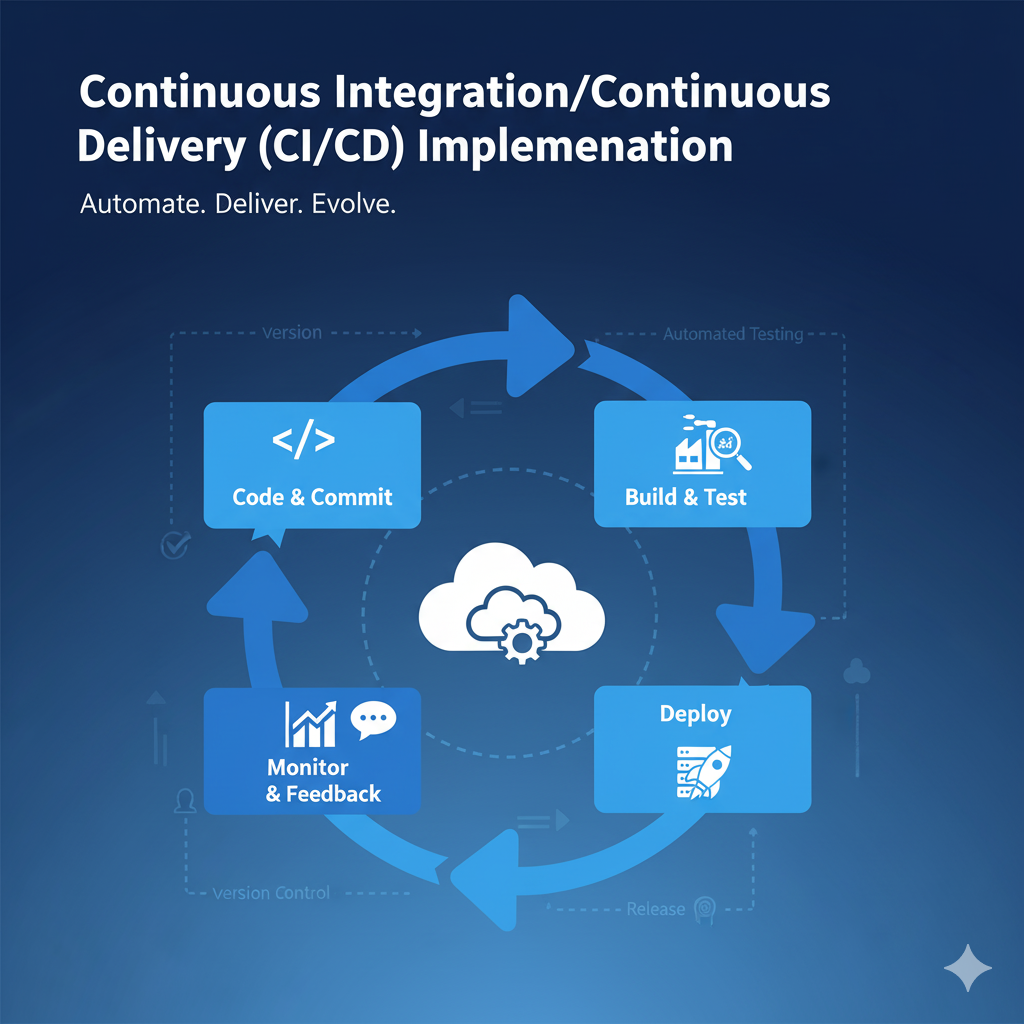
Continuous Integration/Continuous Delivery (CI/CD) Implementation is the cornerstone of modern DevOps, establishing automated pipelines that govern the entire software release process. Continuous Integration (CI) ensures code changes from multiple developers are frequently merged into a central repository and immediately validated via automated builds and testing. Continuous Delivery (CD) extends this by automatically preparing validated code for deployment to production at any time. This fully automated pipeline minimizes human error, drastically reduces the time between a code change and its release, ensures consistently high software quality, and enables organizations to respond to market demands with speed and confidence.
Our Services
- End-to-End Pipeline Design and Automation We design and configure the complete CI/CD pipeline using industry-leading tools (e.g., Jenkins, GitLab CI, GitHub Actions, Azure DevOps) to automate the entire workflow from code commit to final production release.
- Automated Testing and Quality Gates We integrate and orchestrate multiple layers of automated testing—including unit, integration, and security tests—directly into the pipeline, establishing mandatory quality gates that must pass before any code can proceed to deployment.
- Infrastructure Provisioning Integration (IaC) We connect the CI/CD pipeline with Infrastructure as Code (IaC) tools (e.g., Terraform) to automatically provision, configure, and tear down test and staging environments, ensuring consistent infrastructure across all stages.
- Advanced Deployment Strategies We implement advanced, low-risk deployment techniques such as Canary Releases (gradually rolling out to a subset of users), Blue/Green Deployments (using two identical environments), and automated rollback mechanisms to guarantee stability.
- Pipeline Optimization and Performance Tuning We continuously monitor and tune pipeline performance, optimizing build times, configuring parallel test execution, and managing build agents to ensure the fastest possible feedback loops and deployment cycles.
Infrastructure as Code (IaC) and Automation
Infrastructure as Code (IaC) and Automation
Infrastructure as Code (IaC) and Automation is the practice of managing and provisioning computing infrastructure—networks, virtual machines, load balancers, and security rules—using configuration files rather than manual processes. By treating infrastructure setup like software code, IaC ensures that environments (development, testing, production) are consistent, repeatable, and easily scalable. Automation eliminates environment drift, drastically reduces human error in setup, enables rapid resource provisioning on demand, and integrates infrastructure management seamlessly into the CI/CD pipeline, lowering costs and accelerating product time-to-market.
Our Services
- IaC Strategy and Toolchain Setup We design and implement a declarative IaC strategy for your organization, selecting and configuring the best tools for your needs, primarily Terraform (for infrastructure provisioning) and Ansible (for configuration management).
- Environment Consistency and Reproducibility We codify all your environments (development, staging, production) to ensure they are 100% consistent (idempotency), using version control (Git) to track every infrastructure change for auditing and easy rollback.
- Cloud Resource Provisioning and Optimization We write modular, reusable IaC scripts to provision resources (VMs, databases, serverless functions) on major cloud providers (AWS, Azure, GCP), enabling rapid, on-demand scaling up or down based on load to optimize cloud spend.
- Configuration Management Implementation We use configuration management tools like Ansible or Chef to automate the installation, setup, and maintenance of software and operating systems on your provisioned servers, ensuring consistent configurations across the fleet.
- Security and Compliance by Code We embed security and compliance rules directly into the IaC templates (Policy-as-Code), automatically enforcing standards like resource tagging, network segmentation, and access controls during the provisioning process.
Containerization and Orchestration
Containerization and Orchestration
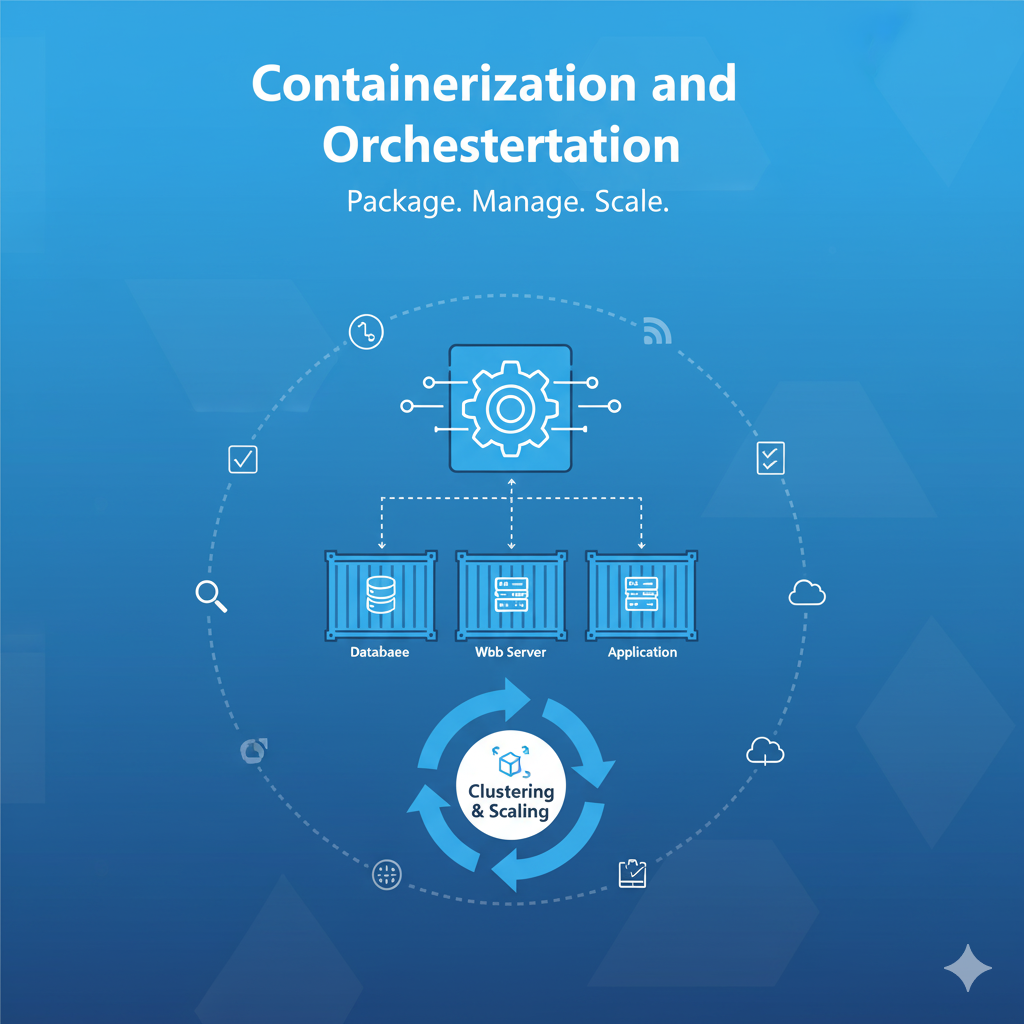
Containerization and Orchestration is the cloud-native process of packaging an application and all its dependencies into portable, isolated containers (like Docker) and then automatically managing, scaling, and networking those containers across a cluster of machines using an orchestrator (like Kubernetes). Containerization eliminates the “it works on my machine” problem by ensuring consistency from development to production. Orchestration provides high availability, automated load balancing, self-healing capabilities, and efficient resource allocation, which is critical for running microservices and rapidly scaling applications to handle enterprise-level loads.
Our Services
- Application Containerization (Dockerization) We refactor monolithic and legacy applications or new microservices into lightweight, portable Docker containers, ensuring consistent execution across any development, testing, or production environment.
- Kubernetes (K8s) Cluster Setup and Management We design, deploy, and manage highly available Kubernetes clusters on public clouds (EKS, AKS, GKE) or on-premise, configuring the control plane, worker nodes, and internal networking.
- Automated Deployment and Lifecycle Management We configure Kubernetes manifests (YAML files) to define the desired state of your applications, enabling automated rollouts, rollbacks, service discovery, and lifecycle management of containers.
- Resource and Cost Optimization We implement smart scheduling, resource requests/limits, and Horizontal Pod Autoscaling (HPA) to ensure containers scale automatically based on demand, maximizing hardware utilization and reducing unnecessary cloud spending.
- Service Mesh and Security Hardening We implement a Service Mesh (like Istio or Linkerd) for complex microservices, adding secure service-to-service communication, advanced traffic routing, and cluster security hardening (RBAC, network policies) for enterprise compliance.
DevSecOps and Continuous Monitoring
DevSecOps and Continuous Monitoring
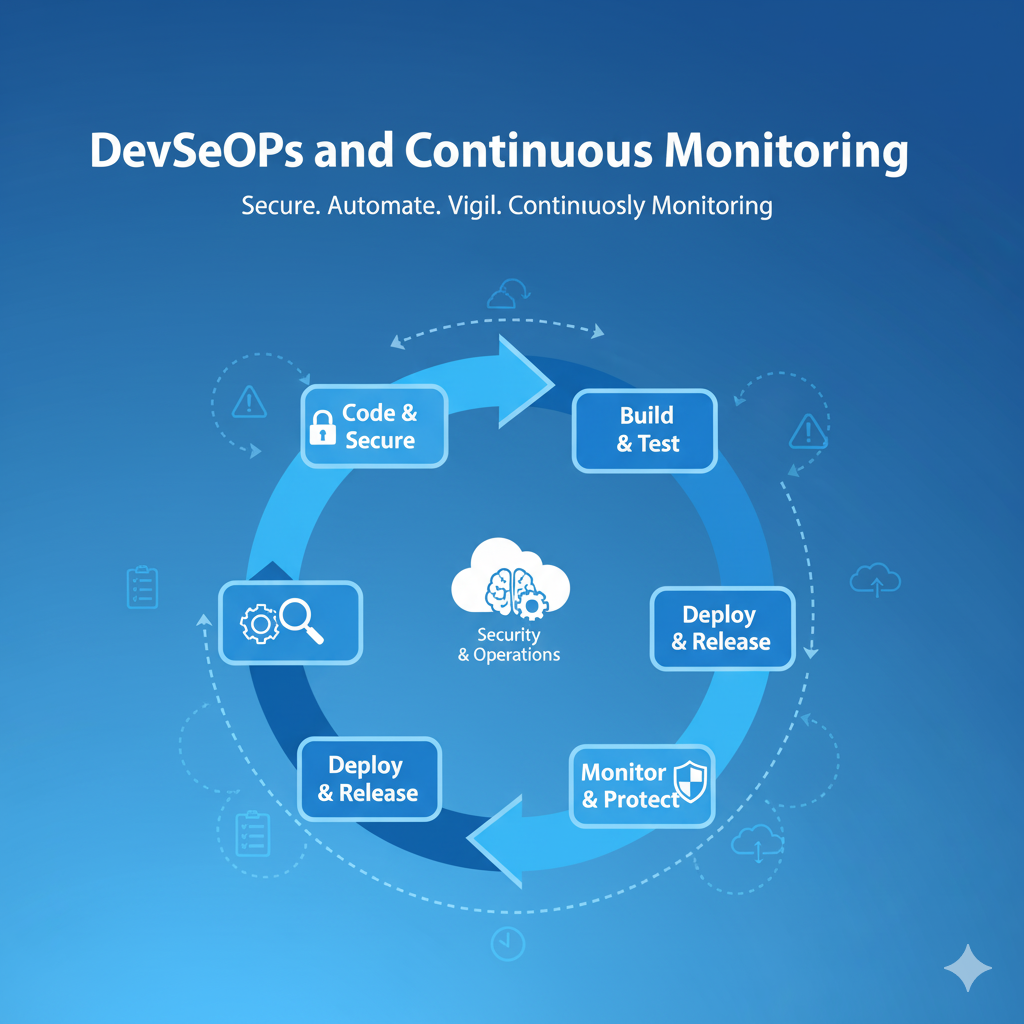
DevSecOps is the revolutionary practice of integrating security into every phase of the continuous delivery pipeline, shifting security “left”—from a late-stage gate to an integral, automated part of development. This ensures that security is a shared responsibility among Dev, Sec, and Ops teams. Continuous Monitoring (CM) then ensures that security, performance, and compliance are observed in real-time after deployment. By automating security checks and establishing constant feedback loops, DevSecOps significantly reduces the risk of vulnerabilities reaching production, lowers remediation costs, and accelerates the delivery of secure, high-quality software.
Our Services
- “Shift-Left” Pipeline Integration We integrate automated security tooling directly into your CI/CD pipeline, enabling Static Application Security Testing (SAST) on source code and Software Composition Analysis (SCA) to scan third-party libraries for known vulnerabilities before code is deployed.
- Real-Time Security and Observability Platform Setup We implement centralized logging, monitoring, and security information and event management (SIEM) tools (like Prometheus, Grafana, Datadog) to provide end-to-end visibility and real-time anomaly detection in the production environment.
- Dynamic Testing and Policy-as-Code We configure Dynamic Application Security Testing (DAST) to scan running applications in staging, simulating real-world attacks. We also implement Policy-as-Code (PaC) to automatically enforce security and compliance rules across the infrastructure.
- Automated Alerting and Incident Response We establish automated alerting thresholds for critical security or performance metrics (e.g., high error rate, unusual network activity) and integrate with incident management systems for rapid, standardized threat response.
- Security Training and Cultural Enablement We provide targeted training to developers on secure coding practices and empower security teams to automate their workflows, ensuring a cohesive DevSecOps culture where security is built-in, not bolted on.